
Movie Review: "Alien: Covenant"


It's interesting how even when "Alien: Covenant" begins with a human crew on a mission to preserve humankind in a state of peace it portrays a sense of persecusion and fear at the same time.

With this second film in the "Alien" prequels, director Ridley Scott goes back to the movie's sci-fi/horror origins, bringing a whole new outlook  with a movie that keeps you closing your eyes, grasping the armrests of your seat and  being in a constant state of suspense, always expecting the worst out of the creature that haunts the protagonists of the story, adding up to the fact that it was awakened by them.
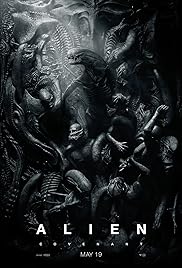
The crew of a colonizing ship set for a remote planet, far in the galaxy, discovers what appears to be a paradise in a dark dangerous world. When the real threat is uncovered, it turns out to be far more unexpected and cruel than what they had imagined, a sudden escape must be attempted.

Despite not moving the franchise in any new directions, it manages to make sense of "Prometheus", which was way too confusing, ambiguous and disconnected from the original "Alien" movies to understand at the time of its release.

Focusing more on the indirect threat that slowly becomes direct and active, the movie shows that the real threat for humanity is humanity itself as the human-created machine originally meant to help humans in their journey of recolonization turns out to believe humans are unnecessary and primitive, completely stripping down the worst of our nature.
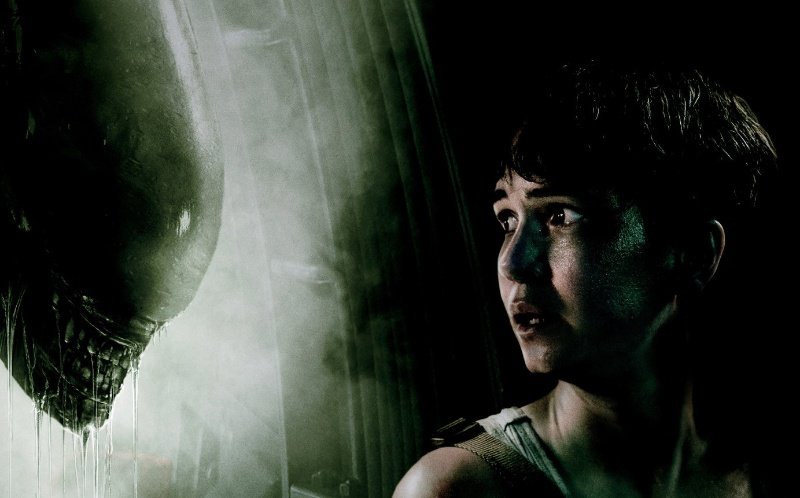
Even with major story flaws and character development issues, Rildey Scott makes "Alien: Covenant" rise from the ashes with incredible camera work, astounding effects and direction.

The performances brought by the cast also help to cover up the fact that the movie is pointless, in terms of franchise storyline, and help disguise most of its flaws while adding depth to apparently shallow characters. 

The film shows what the movie could have been if a little more effort was put during the development process. However it still manages to entertain audiences and deliver a loud and clear message about who the real threat is, and who really has the power to terminate with human existence.


Popular posts from this blog

Top 10 Most Underwhelming Best Actress Oscar Winners

Every year, the eyes of all moviegoers and film fans turn to the Academy Awards, where the members of the Academy of Motion Picture Arts & Sciences  pick the best five performances by leading actresses and end up awarding one. Of course, these recognition is according to the criteria of aforementioned members and sometimes we don't agree with their decisions, but that doesn't mean their mistakes are to be forgotten. In this post you'll find a list of Oscar-winning performances by actress in leading roles that, according to a majority of the public, did not deserve the highest honor in the film industry. Katherine Hepburn, "Guess Who's Coming to Dinner" (1967) Fellow nominees: Anne Bancroft "The Graduate" Faye Dunaway "Bonnie & Clyde" Edith Evans "The Whisperers" Audrey Hepburn "Wait Until Dark" "Guess Who's Coming to Dinner" is the final film of late Hollywood legend Spen...

Screenwiting 101: The Basic Elements of Master Scene Screenplays

On the previous post on the Screenwriting 101 I covered the basic definitions of what a screenplay is, macro descriptions of the starting stages of screenplay development some little advice. Then I posted an entry on the origins of screenplay formatting. If you haven't read any of those two articles, I strongly recommend you do before reading this one. Here are the links: Screenwriting 101 The Origins of Screenplay Formatting Now, in this post I'll be talking about the basic elements of screenplay formatting. If you're planning to write a screenplay right now it is necessary to write it according to the Master Scene Script format, which has six elements that we will touch on ahead. Scene Heading Action Character Name Parentheticals Dialogue Transitions Scene Heading This is the first element, oftentimes known as slug line. All screenplays written in the Master Scene format are broken into individual scenes. Each scene heading is written in all ca...

The Origins of Screenplay Formatting

Origins of Formatting Film goes back to the 1800s, when movies were nothing else than photographic techniques mixed with light bulb effects to create a moving picture effect. These film were called "Scenarios", which were no longer than 40 seconds. The writing for these scenarios were short synopses used both for film description and marketing. For example: Edison's 1897 tale "Pillow Fight" is described as: “Four young ladies, in their nightgowns, are having a romp. One of the pillows gets torn, and the feathers fly all over the room.” John P. Hess. (2017). Proto-Screenplay-The Essentials of Screenplay Formatting. 2017, by Filmmaker IQ Website: https://filmmakeriq.com/lessons/silent-era-scenarios/ But with time it was discovered that different pieces of film could be put together to tell a story. The first screenplays were only written as technical support, so the director knew what to shoot and in what order. Later,  by 1903 it was start...